This is pre-supposed as true when multiple individuals assert different ownership claims for the same good, as they must be asserting that they are the one who is just in directing its use.
Ownership and direction being distinct from one another implies the first comer to be the just director as if they weren’t there would be no distinction between ownership and direction (each latecomer to take the good would gain ownership as soon as they start directing it).
The idea of ownership implies that only libertarian-style ownership is justifiable.
If property borders were not inter-subjectively ascertainable they could not serve to avoid conflicts, which goes against property rights which are conflict avoiding norms.
Property that is not inter-subjectively ascertainable would be authorised by mere verbal decrees. It is however impossible for any passerby to ascertain the existence of this property and know to avoid it.
These criterion for rational property borders highlight communication as being at the root of law. To homestead something you must be able to communicate it’s use to others, otherwise the homesteading fails and ownership is not granted in the first place.
Homestead Stalemates
If multiple people try to homestead the same thing at the exact same time, they are in a stalemate.
If a conflict arises from such a stalemate situation (i.e if a party tries to forcefully exclude another from completing their homesteading) the aggressing party is disqualified from ownership.
Against the Georgist Anti-Homestead Ethic
The Georgist anti-homestead ethic claims that the first possessor also does not possess an ownership right, and that homesteading is a crime against everyone else.
If latecomers have to same right to scarce goods as first-comers, it would make it impossible for anyone to do anything, as you would require consent from all late-comers prior to taking any action.
A latecomer ethic is also incompatible with the NAP.
To argue with someone means to recognise each others right of exclusive control over their body.
Self-Ownership
The homestead principle holds that ownership is granted to the initial directors of external goods. This does not apply to internal goods, i.e ones body, however.
The homestead principle relies on the existence of men capable of acting and extracting goods from nature.
The body of a person is different to any external goods as it is necessarily linked to an actor.
The objective link between the actor and the body is what imbues an individual with ownership.
The nature of ownership is to avoid conflicts.
This fact is derived from the nature of argumentation.
Proposing within an argumentation that someone does not own themselves leads to a contradiction, as you would be pre-supposing that the individual owns their body, whilst stating the opposite.
To engage in argumentation you must accept the validity of other peoples claims to direct use of their own body.
A person has an objective and inter-subjectively ascertainable link to their own body.
The notion of one group owning another must therefore be discarded.
To enslave someone, you must control their body indirectly via coercion in order to make them act how you want.
The slave in such case is still directly controlling their body. This is a superior link to the one of the slaver.
If coercing others to do your bidding constituted a greater claim to an individuals body than themselves, conflict avoidance would be impossible with regards to bodies.
It would be might-makes-right. A conflict authorising system of property. Therefore irrational.
If everyone is co-owned by everyone, you must seek permission in order to take any action, however asking permission is also an action. You therefore must cease doing anything.
It is also impossible to cease action, as to even cease physical motion you would still be acting to attain this state so long as it is done purposefully.
For an ethic to be rational it must be derivable from the nature of the entities it applies to.
There must therefore be a principled difference between the owner and partially-owned groups.
Legal ethics are derived from argumentation, therefore they apply to all beings that can argue.
There can therefore be no relevant difference between different groups of humans with regards to law.
Whether a human belongs to some arbitrary set based on race, nationality, etc. is irrelevant to law, conclusions derived that apply to any set of arguing beings must apply to all of them.
If a conflict arises as to the use of some communally “owned” good, there can only be a single just victor in the conflict.
The democratic “solution” to this problem is to have multiple people own something by way of having a vote as to who should be the victor in a conflict should one arise.
If only two individuals were to jointly own something, voting wouldn’t solve the issue as it could not be any other way than each person voting themselves as the just victor, resulting in a stalemate and failing to resolve the conflict.
Personal note: It seems to me as though the democratic solution fails as in reality none of the people who collectively “own” the good actually own it. If any of the “owners” were to try and use the good for some purpose, and the others did not want it used in this way, they would not be able to use it, and therefore would not own it.
Contract theory is derived from property theory, not the other way around.
Some individual simply signing a contract that states they will grant it to a particular group does not make it validly owned by said group if it cannot be legitimised in a correct theory of property rights.
Another proposed solution to enable the possibility of group ownership is the polycentrist solution, which posits that when conflict arises within a group which owns something, they should consult some arbitrator, i.e a judge to resolve the dispute and decide who has just possession.
This solution posits that law is simply decreed by people, when in reality it is derived from the normative structure of argumentation.
Personal note: seemingly a similar problem to the democratic solution.
A counterexample often proposed in favour of group ownership is that of a company. Multiple people can come together and own shares etc.
This example misses that a company is not something which can be “owned”, it is a specific relationship between individuals.
The property directed by the company must still be owned a singular individual, be it the CEO or someone else.
It could be possible for a contract to exist that cedes the property to someone else under certain conditions, but nowhere does this imply that the property is simultaneously owned by multiple people.
The Blockean Proviso
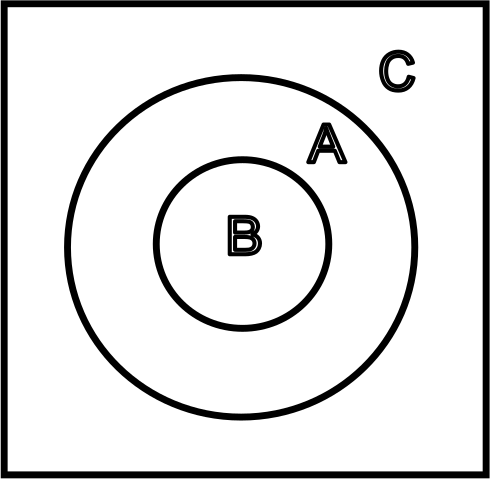
There are people out living in C, and some individual homesteads A but not B.
The person who homesteads A is preventing people from accessing something they do not own (B), which is forestalling.
People in C who may want to access B are both allowed to do so (as it is not homesteaded), and not allowed to do so (as entering B implies entering A which is homesteaded land). This is a contradiction.
It is the nature of property that the owner excludes others from it’s use.
The individual homesteading A then could be said to actually own B as they have homesteaded the surrounding area, and are now excluding others from it’s use.
The notion that unlimited property rights allow for people to aggress using their property is false.
Owning a gun does not mean you have the right to use it for anything you want, but that you have the rights to exclude others from using the gun for what they want.
Basically, when people are in C but not B, homesteading A would also homestead B.
If nobody exists outside in C, but someone is in B, homesteading A would homestead B and C.
If people or homesteaded property exist in both B and C, then A cannot be homesteaded, as doing so would be forestalling. Fencing off A would be claiming possession of the owned property of others.
Direction vs Possession: What is Ownership?
Just direction is a better definition for ownership than just possession.
There are situations in which some person can justly be given permission to possess something, and there is no conflict, e.g letting a friend sit on your sofa (they possess part of the sofa and the sitting room).
The friend is able to justify possession of the sitting room, and so under the definition of ownership as just possession, they are the owner.
The issue is solved through having antecedent vs descendant property rights.
The antecedent right is what allows for a descendant right to exist, and must therefore prevail in a given conflict.
Your property right in the sofa/sitting room is antecedent to the friends right.
This is why just direction is a better way of defining ownership.
On the Impossibility of Intellectual Property Rights